“TAKE COVER”…Ground Cover, That Is!

Garden Series 2/4

In my last post, Garden Series: Plans and Dreams we offically started my garden series where I hope to cover any questions regarding the plans we have for our garden area (which includes the chicken coop)!

I plan to cover majority of topics (size, layout, logistics, design details, maintenance) throughout a series of 4 posts:

So make sure to check back in if you are having questions regarding our garden space, and if you have any other questions/topics you would like me to cover, please send me a message over on my Instagram: @theroostingplace.

Here we are going to talk about methods and materials we use in our garden area for ground cover, and some of the reasoning behind our choices. Originally, we were going to wait and choose a rock material after the fence was up, but realized that we were going to need approx. 10 cubic yards to cover the area of the garden, and therefore would need a delivery truck. And so began my shoveling journey.

In-Ground Beds

When it comes to our in ground garden beds, I till (using this amazing tiller attachment for our weedwhacker) the area, plant my plants using a good splash of Root Stimulator, then use cardboard boxes (usually pulled from the recycle bin) as my “weed barrier”. This is a much more natural way of blocking the weeds, allows moisture to soak in, as well as retains moisture during watering, and will decompose nicely over time, adding nutrients to the soil below.

I have had very little weeds come through in my existing garden beds, and really only notice weeds where there are breaks or rips in the layout of the boxes (with any weedbarrier, a good overlapping method is best to block weeds)! As a general rule of thumb though, if you spend about 10 minutes/ day out in your garden checking and pulling weeds, there is very little “mass” maintenance needed!

One of the most important addition to your garden beds is MULCH. Mulch is a material (such as decaying leaves, bark, or compost) spread around or over a plant to enrich or insulate the soil. Mulch can be dyed or left natural for decorative effects, but mulch is so much more than just a pretty face. Benefits of mulch include, but are not limited to:

  • Reduces weed growth by keeping light from reaching the soil surface.
  • Reduces water loss from the soil surface, which helps maintain soil moisture.
  • Moderates soil temperatures, keeping it warmer on cold nights and cooler on hot days.
  • Protects bare soil, reducing erosion and soil compaction.
  • Protects plants from the harsh conditions of winter freezes, thaws, and winds.

We currently use natural, untreated mulch in our beds as well as the chicken run, but I am considering buying black mulch (beds only) to give a pop of contrast. No matter what color you choose, be sure to add mulch, and refresh/replace the mulch as needed to avoid any disease.

Edging

Several months ago, I saw this add on Facebook selling pallets of leftover brick pavers for $25/pallet, so we jumped on it and these pallets have been sitting in our yard ever since, just waiting to be used. Pavers are great choice for edging. I love the way they flow naturally with the rock ground cover we chose, and to me they add in another element of nature.

Here are some pavers similar to the ones we use:

Gravel Groundcover

When it came to the vision for this space, I always envisioned covering the entire area with some form of gravel/rock material. The benefits of doing this include:

  • Less/ viturally no weeding
  • No mowing/weedeating to keep it manicured
  • Barefoot friendly
  • Deters animals from using this space as a bathroom
  • Creates a beautiful, cohesive look

The Material:

We ordered 10 cubic yards of crushed limestone, which will cover the entire area with about 3″ of depth.

Why crushed limestone and not pea gravel?

I’m so glad that you asked. When we visited our local stone yard, I was under the impression that pea gravel was the obvious choice, however, after discussing with the rock-man the intention for the stone, I was then shown this beautiful crushed limestone as an alternative to pea gravel. The reasoning? It packs down much better, making it the better option for footpaths and rolling cart wheels over! I can still comfortably walk on this rock barefoot, and I especially love how it changes color when wet!

The Process:

The moment I realized just how much 10 cubic yards of rock was

Materials needed:

  • Weed Killer or Till the Area
  • Weed Barrier (I used a combo of Landscaping Fabric and Tar Paper)
  • Landscaping Pins
  • Wheelbarrow
  • Shovel
  • Rake
  • LOTS OF ROCK

Because this area is massive, and because it is mosly dedicated to walking paths, I was not about to use the tiller to get rid of the existing grass and weeds. Instead, I used Round Up to kill the existing ground cover. I sprayed it all thouroughly, and went over the tough areas twice before rolling out my weed barrier.

Landscaping Fabric:

  • Pros:
    • drains well
    • Safe for planting
  • Cons:
    • Rips easily
    • Weeds can poke through over time
    • Expensive

Tar Paper:

  • Pros:
    • “Heavy duty”
    • Less ripping
    • Thick
    • Cost effective
  • Cons
    • Takes longer to drain
    • Can be harmful to plants

I used the above pros and cons of both these materials to my advantage. I placed the tar paper on majority of the areas where I knew would only be walkways and placed landscaping fabric in areas where I forsaw the water flowing down to, or areas closer to my garden beds; by doing this method I saved a good amount of money! (Fun Fact: you can also use old roof shingles as a weed barrier in walkways!)

We used landscaping stakes to secure the barriers, then got to work. Wheeling and Shoveling and Raking, repeat, repeat, repeat.

Overall, it took me about a week and lots of wheelbarrow loads to completely spread all the gravel evenly under the Texas summer sun while Harley was working, but the end result is so worth it. This rocks tried to crush my spirit but I proved to be more resilient than I even knew, even if I did sleep for a week straight when this part was done. 😉


As another postitive out-take: I rarely have to weed any of this area, and when I do I’ve noticed it is just this one pesky species of weed that always finds a way to pop up, but they’re extremely easy to pull so this method is very managable when it comes to weed control. So if that doesn’t motivate you to try hardscaping your garden area, I don’t know what will!

Talk Soon,

xx, Lanna

Check out my last post: Garden Series: Plans and Dreams to see the inspiration behind this space, and check back next week to learn about our fence!

Sources:

https://www.almanac.com/types-mulch-advantages-and-disadvantages-mulching


Plans and Dreams

Garden Series 1/4

Today we offically start my garden series where I hope to cover any questions regarding the plans we have for our garden area (which includes the chicken coop)!

I plan to cover majority of topics (size, layout, logistics, design details, maintenance) throughout my next 4 posts:

  • Plans and Dreams

So make sure to check back in if you are having questions regarding our garden space, and if you have any other questions/topics you would like me to cover, please send me a message over on my Instagram: @theroostingplace.

The Space

Our assumption is that this approximately 64’X72′ area was most likely once used as a goat pen because there was evidence of fencing (and remaining fencing) surrounding this space. Here you can see we had already begun to stake out the area for our chicken coop when I took these.

While we are redoing the fenceline, I am extremely grateful to the old fence, as its borders inspired the perfect garden area.

We removed the old fence (we salvaged as much of the wood as we could because I have an idea for it on a later project), for several reasons: it was falling apart and leaning, there were only two complete sides and the fenceline curved severely making attaching a new fence complicated, and this is not the style of fencing I have in mind long term. So goodbye old fence, and soon I will tell you all about my new fence that will be going up.

Additionally, the whole area slopes slightly towards the pond, and other than building areas, we are leaving the slope to prevent flooding. So some areas are a little “wonky” but nothing that is a major problem.

Swipe the bar to remove the old fence!

The Dream

We’ve got big dreams for this “area”! The end goal is to fill this space with the following features:

  • Chicken Coop– check (total building area is approx 180 sqft)
  • 6 raised garden beds-2/6 check
  • Greenhouse (160 sqft)
  • Sitting Area
  • Water Feature of some form
  • String Lights
  • Flower beds, lots of flower beds

Below you can see a rough layout for all the garden features. I’m sure this will be tweaked, but I am a huge proponent of having a physical, drawn out plan in place to reference throuout the process.

The Inspiration

European cottage, but make it Texas. That’s what my ultimate goal is, however, as much as I am drawn to nuetral white and purples in photos, in person I can’t help but grab colorful blooms, so who really knows how this will turn out. Feel free to swoon as hard as I did over these beautiful inspiration pics.

Realistically, I pull pieces from each of these photos and spaces, because each is different. But they all scream “peace” to me. The creeping vines, the mixed tones and materials, the fine line between order and chaos…OOOO I love it all! Ultimately, no matter how my garden ends up, I want it to be a place of peace and serenity. Clearly, a Texas garden will grow what it grows, but I want this space to be a place of rest and growth, and a place for learning, no matter how it looks. I truly believe that the act of tending to the earth brings our spirits closer with God’s creation, and I cannot wait to watch this space flourish.

Talk soon,

xx, Lanna


Hallway Board and Batten Wall

The board and batten hallway wall is DONE! In all honesty, I started this project over a month ago, and this is one one the quickest projects to complete…if you order enough wallpaper to begin with…YEP. I only ordered one roll (I needed three) of this beautiful wallpaper from Wallery, and I realized the moment I was going to put it up. Huge fail on my part, but hey, live and learn. While I have officially dubbed this small, dark hall as my “home’s most challenging place to photograph”, this area turned out to be exactly how I envsioned it, and I am super excited to have a beautiful, yet functional, spot to “dump” all those jackets and bags that always pile up in random places!

Links +Deets:

Board and Batten Basics:

I’m sure you noticed, but I have textured walls. Because the price of lumber is outrageous accross the board and we just built our chicken condo, I opted to let the texture slide and didn’t glue board behid my battens. If you want a smooth finish, use liquid nails to put up a back board (like a wall panel or thinner piece of smooth plywood, idk I didn’t do this don’t quote me) then place your battens on top.

I used 1″X2″ MDF boards for my vertical boards, and 1″X4″ MDF for my horizontal top boards. These are attached with nails (use a level to ensure they are straight), then fill any holes with wood filler and caulk the gaps to give a seamless appearance. Before applying your favorite paint, be sure to prime your boards. This ensures that the paint sticks properly and doesn’t soak in. That’s pretty much all there is to it to board and batten walls-its a super easy and fast project that quickly transforms a space.

Paint: Herb Bouquet by Benjamin Moore

I love how the green board and batten combined with aged gold hooks ties my small living/kitchen area into the hallway! I used Herb Bouquet by Benjamin Moore (but in Sherwin Williams Duration paint, we like the quality better). Every time I use this paint, I am transported into a cozy, earthy wonderland, and I am convinced this may be the perfect shade of green/gray for home accents.

Wallpaper: Shadow in Gray by Wallery

This wallpaper is the perfect additon to this space. I love how sublte the design is, and how it adds a delicate drama the space without crowding this small hallway. I will note that the white background does make the seams between pieces a tad more noticable than darker wallpapers I have used in the past.

Hooks: Gold Metal Double Wall Hook

I searched the internet high and low for the perfect gold hook, and these were perfect for the price. I may even buy some more to add to this wall..TBD.

Accents/Decor

Talk soon,

xx, Lanna


Chicken Friendly Herbs

And their benefits!

Did you know that there are several plants and herbs that are totally safe and beneficial to your chicken’s health? By adding the following herbs in/around your chicken coop, or by including them in your chicken’s diet, you can reduce the probability of several health risks. I have placed several of these inside my coop, and plant to add more over time!

Sage:

Sage in high in Vitamin K, which aides in blood clotting. Sage also serves as a cleaning agent, pesticide, and antioxidant, which can help in the prevention of salmonella.

Oregano:

Oregano has several antibiotic factors, and is packed with several nutrients such as Vitamin K, manganese, iron, Vitamin E, tryptophan and calcium. Becasue of this, oregano helps fight e.coli, salmonella, coccidiosis, and avian flu! This herb is being studied as a broad-spectrum natural antibiotic on large poultry farms! You go oregano!

Lavender:

Lavendar is high in Vitamin A (useful for eye health), calcium (bone strength), and iron. Not only does it smell lovely and can act as an air freshener, it is known to be a natural insect repellant, and contains antioxidant and anti-inflammatory properties, which can reduce stress.

Rosemary:

Benefits: Rosemary is high in manganese (useful in metobolic health). Not only does rosemary smell great, it is known to be a natural insecticide, has antioxidant properties, assists with pain/stress relief and can enhance respiratory health. Studies have shown that the carnosic and rosmarinic acids in rosemary have powerful antibacterial, antiviral, and antifungal properties.

Mint:

Mint contains trace elements of Vitamin A, iron, potassium, magnesium, calcium, and phosphorus. Mint is a great insecticide and also can keep mice away. Any of the mint varieties (including catmint, peppermint, and spearmint) can be fed to chickens, and also can have a calming effect.

Lemon Balm:

Lemon balm is high in flavonoids, which can have an antioxidant effect. Due to several chemical properties that attribute to scent, (one being citronellal) lemon balm is a natural mosquito repellant,can keep rodents away, and may relieve stress in flocks.

Thyme:

Thyme contains thymol and small amounts of other nutrients such as potassium, vitamin A, vitamin C, and magnesium.  Thyme is a natural insect repellant, has antibiotic properties, and also aides in respiratory health.

Basil:

Basil provides macronutrients, such as calcium and vitamin K, as well as a range of antioxidants, which aide in overall immune health.

Comfrey:

Comfrey is rich in vitamins A and B12 and can aid in a rich yellow color to yolks. Comfrey is high in protein and low in fiber, making it a great addition to your chicken’s diet.

These are just a few of the nutrient rich herbs you can add to your coop to aide in chicken health! Feed them dried or fresh to your chickens, add them to nesting boxes, or hang them around the coop to freshen the air!

Talk soon!

xx, Lanna

 “The birds are capable of…break[ing]… nutrients… down to their individual pieces and reassembl[ing] them into something that we enjoy eating. This is only possible if we provide them with all of the nutritional building blocks necessary for the job.”

-Justin Fowler
“Nutrition for the Backyard Flock”

Sources:

Brazier, Yvette. “Basil: Uses, Benefits and Nutrition.” Medical News Today, MediLexicon International, 16 Dec. 2019, http://www.medicalnewstoday.com/articles/266425.

Brennan, Dan. “Rosemary Health Benefits, Nutrients per Serving, Preparation Information, and More.” WebMD, WebMD, 18 Sept. 2020, http://www.webmd.com/diet/health-benefits-rosemary#1.

Brennan, Dan. “Thyme: Health Benefits, Nutrients per Serving, Preparation Information, and More.” WebMD, WebMD, 19 Sept. 2020, http://www.webmd.com/diet/health-benefits-thyme#2-4.

Glassman, Keri. “Oregano: An Herb Fit For Your Kitchen and Medicine Cabinet.” WebMD, WebMD, http://www.webmd.com/food-recipes/features/why-is-oregano-good-for-me#:~:text=Fresh%20oregano%20is%20a%20great,vitamin%20E%2C%20tryptophan%20and%20calcium.

Harrison, John. “Feeding Comfrey to Poultry and Other Livestock.” Allotment & Gardens, http://www.allotment-garden.org/comfrey/feeding-comfrey-poultry-livestock/#:~:text=High%20Protein%20%E2%80%93%20Low%20Fibre%20Comfrey&text=Comfrey%20being%20low%20in%20fibre,the%20expensive%20corn%2Dfed%20hens.

Meyers, Michelle. Lemon Balm: An Herb Society of America Guide . The Herb Society of America, 2007, http://www.herbsociety.org/file_download/inline/d7d790e9-c19e-4a40-93b0-8f4b45a644f1.

Nordqvist, Joseph. “Lavender: Health Benefits and Uses.” Medical News Today, MediLexicon International, 4 Mar. 2019, http://www.medicalnewstoday.com/articles/265922.

Raman, Ryan. “12 Health Benefits and Uses of Sage.” Healthline, Healthline Media, 14 Dec. 2018, http://www.healthline.com/nutrition/sage.

Singh, Manpreet, et al. “Nutrition for the Backyard Flock.” University of Georgia Extension, 1 Apr. 2020, extension.uga.edu/publications/detail.html?number=C954&title=Nutrition+for+the+Backyard+Flock#:~:text=Calcium%2C%20phosphorus%2C%20and%20salt%20are,eggshell%20formation%20in%20laying%20hens.

Ware, Megan. “Mint: Benefits, Nutrition, and Dietary Tips.” Medical News Today, MediLexicon International, 4 Dec. 2019, http://www.medicalnewstoday.com/articles/275944.


DIY Upholstered Headboard

Hello friends! We have finally made it to the final project that completes this Murphy Bed: a headboard! I knew that this space wasn’t fully finished until I added this special detail, and I feel like it pulls everything together perfectly. (I’m pretty sure my pups think this bed was made specifically for them!)

When we decided to build a murphy bed into this space, my biggest caviat was the appearance of the structure. This addition needed to be a part of this house, and I still wanted to give a cozy, homey vibe while maintaining the multi- function purpose of this room. I think we have done a pretty stellar job achieving that goal, but when I pulled the bed down, the space just looked…unfinished. So I decided to DIY a beautiful, soft, comfortable headboard! Here’s how I did it:

You can find real-time projects and updates on my Instagram: @theroostingplace

Materials:

  • 1 sheet 3/4″ plywood (If you want a sturdier headboard, use 1″ plywood. I opted for the thinner so it fit inside the folded bed)
  • 2 rolls of 24″x72″x1″ project foam (you can also use thicker foam and buy it by the yard if you want, I found this was cheapest)
  • Quilt Batting
  • 2 yards upholstery fabric of choice*
  • Staple Gun + 3/4″ staples
  • 29 buttons of choice
  • Super Strong Fabric Glue (Aleene’s or E-6000 work great)
  • 1/2″ hooks
  • Hanging wire or D-ring hangers

The Process

Determine the desired shape of headboard, then draw it out on the plywood. A standard queen headboard should be 62-65″ wide, depending on the amount of hangover. (As for height, I made my headboard 3 feet tall at the highest point, which I feel is pretty standard. You can make yours taller, just keep in mind that the amount of extra material you may have to buy.)

I opted for the “cleveland” style. To draw out a rounded top, use a pencil and attach a piece of string to it. Hold the other end of the string, and pulling taut, use the pencil to create an even arch. I then used a bowl to get the extra curves on my edges. Using a jigsaw, cut out the drawn shape.

Next, lay out and stack batting, then foam, then plywood. Mark out the edges of the headboard giving an additional 2″-this will ensure enough material to wrap over the top of the board and be stapled to the back.

First, staple the foam by pulling the pieces tight over the edges. Start at the “break” between the 2 pieces of foam and staple the sides first to prevent a split in your foam. Then pull the edged tight and staple all the way around. Repeat the process with the batting. (Batting diminishes the appearance of the split in the foam. You can double the batting up if you wish.) Even with my goof split, my batting hid it and paired with the upholstered divets, this isn’t noticable at all.

To create the upholstered look, flip the headboard over to the front, then lay the material over the top. It is important to not attach the edges first to ensure there is enough slack for the divets. Meausure out placement for the first divet- I chose 12″ apart and eyeballed my first placement. Use the stapler to make an X and create a divet. Measure 12″ over and down and repeat until there are enough to make you happy.

Once all the divets are made, flip the headboard back over and staple the fabric around the edged and to the back, pulling the fabric tight to avoid unwanted wrinkles. *(tip: when picking your fabric, check out the sale fabric section! I got 2.5 yards of fabric for 50% off the original price plus most places will give an additional discount for buying the end of bolt*

While you are back here, attach your hangers! Use a level and a measuring tape to screw your hangers of choice into the back of the headboard. ** (I used wire and screws because I didn’t want to go back to the store, but you can also use d-rings to make your life simpler.)

Flip the headboard over again and use the glue to attach buttons. Let the adhesive dry before moving the headboard to a vertical postion to ensure best adhesion. While the glue dries, let’s attach our hooks to the wall!

Because my support board for the murphy bed was a few inches off the wall, I used a stud finder to locate studs and screwed a 2X4 into the wall as an “extender” so the headboard could sit flush. Using a drill bit, first make a small pilot hole, then screw the hooks into the wall. Make sure to measure out the distance of your hangers then place your screws. If you are attaching directly to the wall, skip the 2×4 step and simply insert your hooks directly into studs. **Also, if you aren’t attaching to a 2×4, you will want to locate studs first before attaching the hangers to your headboard.**
Last step is to hang it up and to stare blissfully at your beautiful creation! The end! Mine sits perfectly when we fold and unfold the bed, and gives such an elegant final touch to this space. While it has it imperfections, I’m overall super pleased with the look and cozy feel it brought to this room! Now my guests have a place to comfortably rest, and I hope gives them a home-away-from-home comfort.

Let me know if you make one and if this method works for you!

Talk soon,

xx, Lanna


Murphy Bed: Chasing the Rainbow
Choosing a paint color

If you’ve been following along on our Instagram, you’ve already seen what we picked for our Murphy Bed color, but for those of you joining us here, I cannot wait to reveal this BEAUTIFUL color to you! I was deciding between 20 different colors (I know, I had no clue what direction I wanted to head.) But this beautiful blue is the perfect compliment to this space!

For more updates and projects, follow my Instagram: @theroostingplace

When I first started out with this project, I planned on leaving the bed and shelving units white. However, after living with them, I felt that the space needed something more! Break out the paint swatches! After collecting 20 swatches, I narrowed it down to the ones below.

My rug is from boutiquerugs.com and I absouletly love it! The colors are beautiful and the texture is so soft! I would reccomend adding a rug pad if you like thick rugs.

I finally I bought sample sizes of 6 colors to test on the bed. I highly suggest testing any paint contenders in the space they will go. Colors can look different in all lighting, as well as the time of day so by physically placing the color where you want it, this garuntees you love the choice you make! I opted out of the pink mainly because I wanted this room to flow with the other greens and blues of the house scheme…but you better believe I will be using Pressed Flower in the future because WOW. Every single one of these colors would have complimented this rug beautifully…so let the testing begin…

Once I decided on a color, we taped off the front of the murphy bed so that we could spray using our WagnerFlexio 590 paint sprayer. I love this sprayer because it is lightweight, has 2 different spraying direction options and multiple spray settings. Great for beginner projects! By using a sprayer, I was able to get into all those small seams of the murphy bed front design, and get an even coating. Had I not decoupaged the shelves, I would have sprayed everywhere, however we had to roll and cut in by hand our shelving units to make sure we were precise.

I forgot to mention that we also added crown molding to our shelving units, and painted after we had caulked all the seams to give a uniform “built in” finish to the whole piece. But for the moment you all have read to find out: my final color choice was Smoky Blue by Sherwin Williams. We used a satin finish in their Duration paint to ensure a tough coat since this piece will get a lot of wear and tear over the years.

Overall, I love that I decided to add color into this room. It typically is difficult for me to go bold in color when it comes to large, permanent pieces, but in this little house, I am learning to trust color! This room calms me down and allows me to escape from the hectic chaos that fills these walls, the blue just makes me happy! Next week, I’m going to fill you in on how to make a super easy “upholstered” headboard like the one I added inside the Murphy Bed!

Tell me, what do you think of using bold colors? What holds you back from trying out new things? For me it’s the fear of the unknown…but we are getting braver every day!

Talk soon,

xx, Lanna


DIY Cement Planter

Okay y’all. This planter was a rollercoaster for my emotions, and caused me to question every single step I took, but the end result is AMAZING! I really love the look of tall, cement planter you can buy from various stores, but I refused to spend upwards of $100 to get one. So I decided to make one myself out of two 5 gallon buckets and only spent $12 (not including tools)!

You can find saved videos and other DIY projects on my Instagram: @theroostingplace

Materials:

  • Two 5 gallon buckets
  • Extra bucket to mix concrete in
  • 2 80lb bags of Mason Mix Type S Mortar by Quickcrete (you will have cement left over)
  • Approx 3 ft. Chicken Wire or Hardware Cloth Wire (the chicken wire was easier to manuever into a rounded shape, so it depends on the look you want)
  • 1/4″ screws
  • Rubber Gloves
  • Concrete Trowel
  • Concrete Sanding Block
  • Tarp to lay on work surface

Process

Lay a tarp on the ground (I used a contractor trash bag, it doesn’t matter what you use as long as your work surface is covered-it will get messy!). Remove the wire handles from your buckets and cut off the bottom of one of the buckets. Then stack the two on top of each other with the original openings touching. (The newly cut hole is at the top now.)

(I hadn’t laid my tarp down yet and regretted it, lay the tarp down!)

Next, attach the wire to the sides of the buckets using screws. (I experimented with two different types of wire, mainly because it is what I had on hand). Chicken wire is more flexible and will allow a more “curved” pot, while the hardware cloth will result in a straighter pot. Either is fine to use, but if this step is skipped entirely, you will find yourself running to the hardware store anyways-CONCRETE WILL NOT STICK DIRECTLY TO THE BUCKET. Yes, I tried it and it failed miserably. Trim the top of the wire to be even with the top of the bucket.

Here I tried to put concrete on without wire, and found out the hard way the concrete needs the wire to stay in place. Use the wire.

After putting on gloves (and a mask if you don’t like breathing in tiny concrete particles—maybe one day I’ll learn to put my mask on more often…) begin to mix the concrete. By mixing small amounts at a time, this gives more time to work with the concrete before it dries out. Add in small amounts of water at a time and use your trowel to mix until the concrete is somewhere between a thick pudding and cooked oatmeal consistency. If the mixture get too watery, slowly add a little more dry concrete until the right consistency is acheived. (You will learn as you go what the best consistency is, so if its not perfect the first time don’t worry.)

Begin to “smoosh” the concrete through the wire with a gloved hand. On the bottom half, the concrete will fall to the bottom and hit the ground-this is okay, just keep building it up. Once the wire has been filled in, plus a little more, STOP adding concrete. This takes several coats and if more is added it will keep sloughing off. Take the trowel and begin to smooth over the wired surface, then leave it to dry for several hours, seeing a noticable lightening in color indicates the coat is dry. (It looks ugly at this point-I promise it will get better!)

Once the first coat (or brown coat) is dry, it’s time for coat number two. I found applying with my gloved hand and smoothing over with the trowel was the easiest way too apply coat number two as well. Fill in any low or uneven spaces, smooth, then leave it alone to dry!

Once this second coat has dried, it is time for the final coat! For this coat, place a small pile at the base of the planter, then use the trowel to slide the cement up the side for a smooth finish. Use a gloved hand to add cement to any uneven spaces, the smooth again with the trowel, beginning at the bottom and working upwards. I also found that just smearing on the top coat with a gloved hand (no smoothing) gives a unique texture as well, so play around and see what you like best! Because the trowel is straight, it can be difficult to get a perfectly round, smooth finish, so keep this in mind and be playful with the look!

When final coat is throughly dry, use the concrete sanding block to smooth out rough edges. Smooth in a vertical direction to go with the lines created by the trowel.

Dust off excess concrete (I used a broom), and drill holes in the base if you forgot to at the the beginning (@me).

Now it is ready to be moved to it’s new home! NOTE: the planter will be heavy- it is advised to move it using an extra set of (strong) hands! For me, this is right next to our front door. For now, I placed the pot my fern came in directly into the cement planter, but aim to fill the pot halfway with mulch and the remaining space with potting soil.

Cost Breakdown

As a disclaimer, I only spent $12 (not including the tools) because we get our 5 gallon buckets for free with a contractor account through Sherwin Williams, and we already had the wire on hand. So I decided to give an honest breakdown of what this project realistically cost!

For a grand total of $50! ($30 if you don’t include the trowel and sanding block which can be reused for other cement projects!)

I love how this turned out though I will say, if you are looking for a smooth finished surface this is not the method for you! This will not create a “perfect” finish, and I suggest trying to make a cement mold instead of using a coating. But if you are looking for a more natural cement planter, without spending $$$, give this a try and let me know how it works for you!

Talk soon,

xx, Lanna


From Shack to Home: Build Me Up, Buttercup Baby

Last I talked about our demo process of Little House- the first step to turning this shack into our temporary home until our “Big House” is built. It took us several months during the heat of Texas summer to flip this shack into what we know now, and are still doing work on it to make it feel like home. We aim to turn it into a guest house/AirBnB once we move into the Big House, so the aim of this whole process is to make it homey for now, and for later.

You can find all our current projects on my Instagram: @theroostingplace

If you haven’t read my previous demo post, check it out here!

Little House Gets New Walls

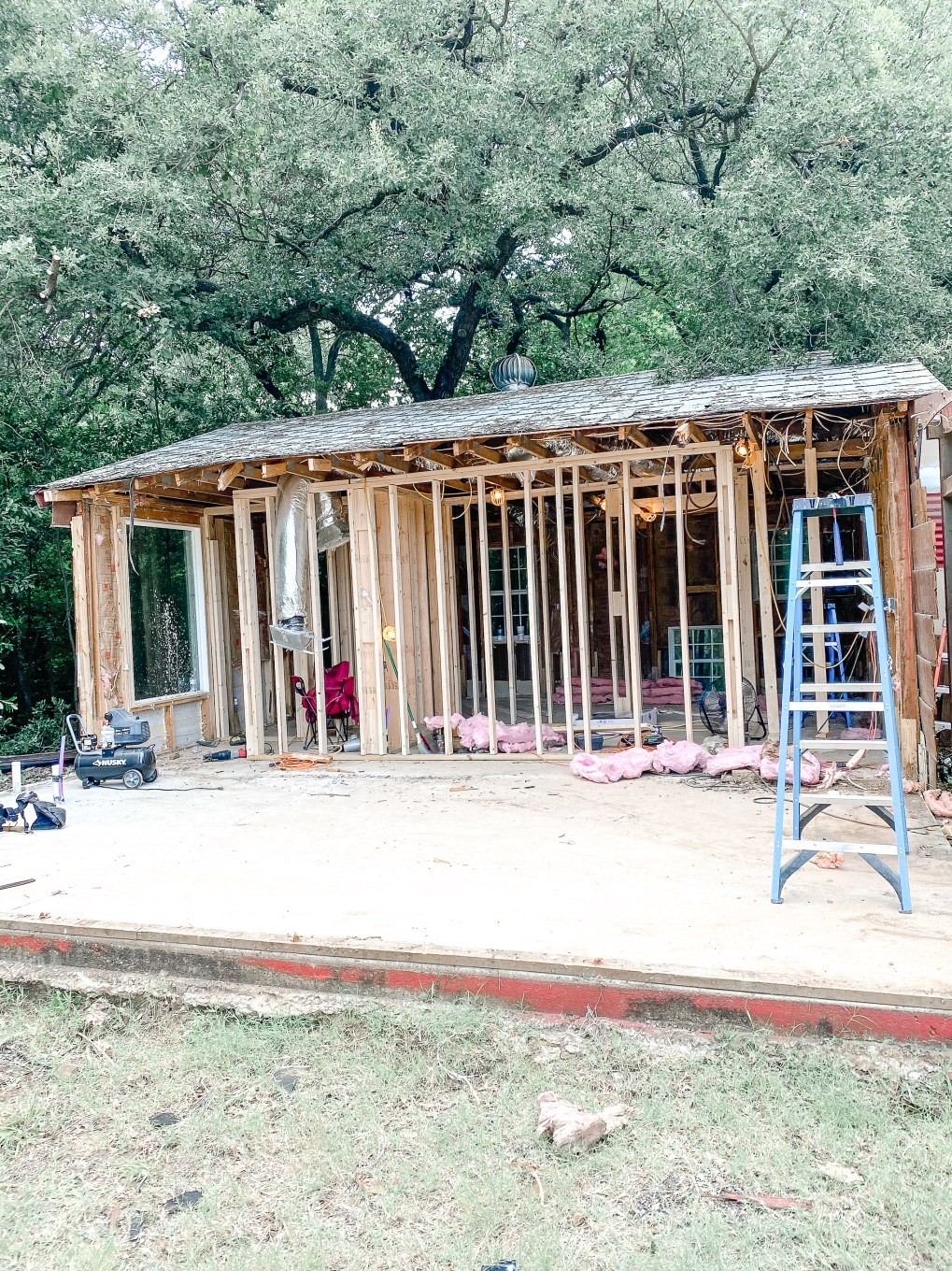
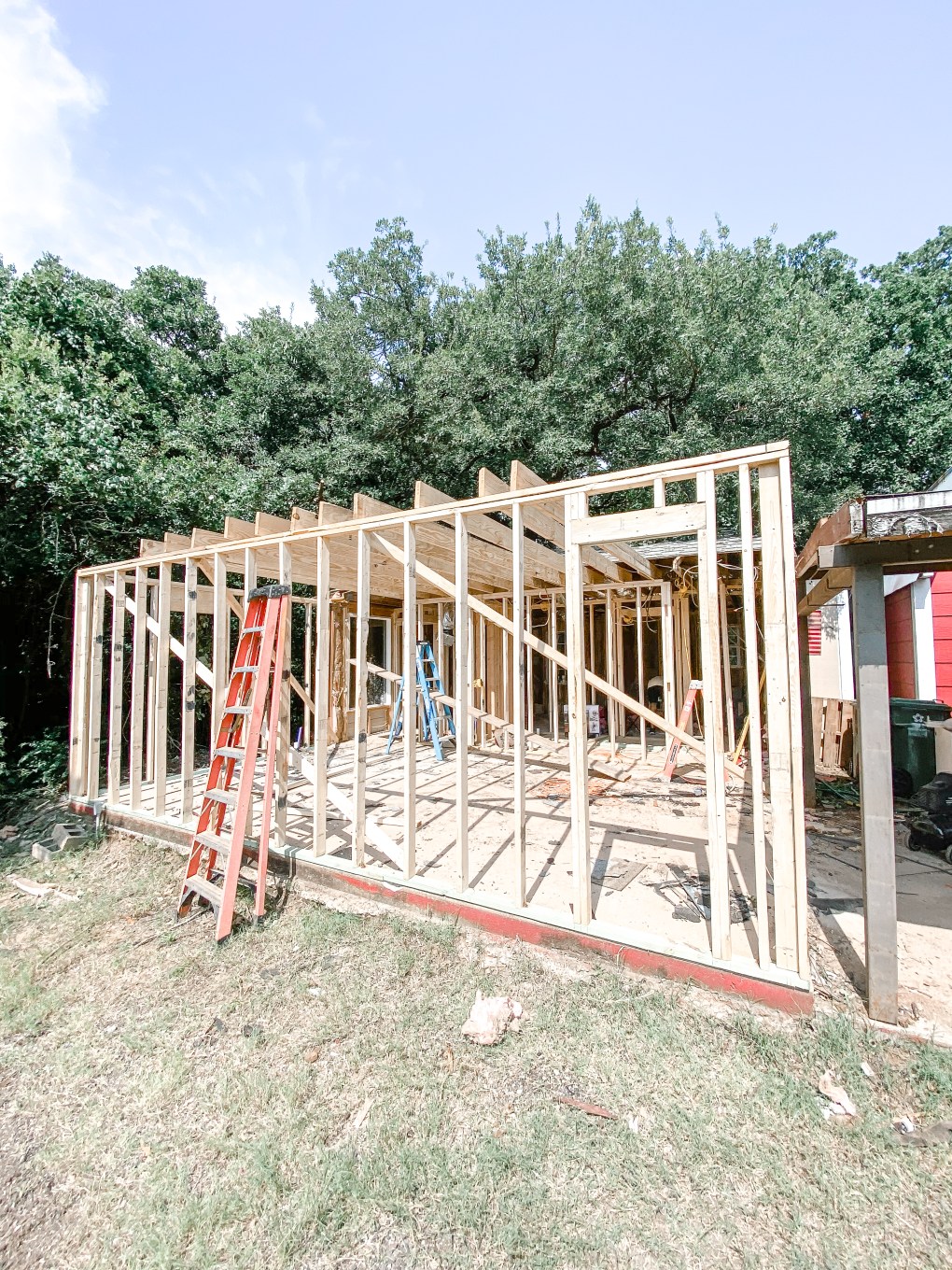
Where we left off: we removed the front half of the house! Once we demo’d the front half, it was time for a group of framers to come in and reframe the front and add a new roof. This was another one of those moments where we knew that it was time to call in the pros-there are certain jobs I just don’t trust ourselves to complete and the roof seems pretty important. It was also July and extremely hot, no thank you.

Because our goal was to sell our old house in Houston and be able to move into this house by September, we also chose to hire out placement of the exterior siding and the roofing so the job could get done quickly and correctly. We probably could have done these, but as I mentioned earlier it was July turning into August in Texas, and I chose a black standing seam metal roof for the house….those poor men did an excellent job (I did tell them I was sorry for my color choice and the timing, but love how it looks so their hard work was worth it!) We chose to paint the exterior Alabaster by Sherwin Williams, which in the evening will pull yellow-you have been warned!

Now this little building is looking more like a house! Next we move onto interior. Harley and his dad ran all the A/C ductwork, as well as the electrical. We used the existing electrical box and A/C unit, just replaced/reconfigured wiring and ducting.

Blessing the House

Once all our interior walls were built, before we installed insulation and sheetrock went in, I asked our friends and family to send us a Bible verse or quote that was special to them. We then wrote all these on the studs throughout our home, and prayed over the house. This was a very special moment to us both, as we plan to spend the rest of our lives on this property, and wanted to ask a blessing over all who entered these doors. I plan to repeat this event with family and friends in attendance once the Big House framing is complete. I have a digital guide in the works that will be available for purchase that will provide an extensive list of verses we used, organized room by room! It will be coming soon!

Let’s Add Some Flesh to Those Bones!

We were then ready to insulate and sheetrock (yep, hired out the sheetrock because it’s heavy and we were pressed for time).

Once sheet rock was in and textured (I originally did not want texture, and will not be using any in the Big House), we could officially paint, and install floor. Tip: to make it easier to choose a paint color, paint your samples on foam boards! This way you can move them from wall to wall or room to room to compare lighting ! Colors look different in different lighting so be sure to place your testers in all areas at different times of day to best gauge your preference. We also set up a paint tent outside which we used to spray our baseboards, which made it much easier than having to paint them post install.

The interior paint color I chose for walls, trim, and ceiling is Chantilly Lace by Benjamin Moore, but we color matched at Sherwin Willaims using their Duration paint line in a matte finish. (Many people prefer satin in order too easily clean, but I haven’t found a major issue cleaning my matte finished walls).

For me, this is the perfect shade of white for interiors. I don’t find that it pulls too yellow or too blue, and looks beautiful with our black contrasting doors.

That’s where I will end for now. Next, we will talk about intalling flooring, and outline the vision for our precious kitchen!

Talk soon,

xx, Lanna


Decoupaging Shelves: Mod Podge vs Elmer’s Glue

Decoupaging is a simple way to add personality to any surface, and when I heard of a “cheaper” way to apply paper via glue I knew I had to test it out. Keep reading to see which method I found to work best for me and my Murphy Bed Shelving Back project!

You can find this and other DIY projects on my Instagram @theroostingplace.

de·cou·page /dāko͞oˈpäZH/ the art of decorating surfaces by applying cutouts (as of paper) and then coating with usually several layers of finish (such as lacquer or varnish)

Merriam-webster dictionary

How to Decoupage

The process of decoupage is a fairly simple art:

  1. First, apply a layer of glue (typically Mod Podge) which can be slightly watered down for smoother application to the surface of desired project.
  2. Then apply a layer of glue to the back of chosen paper.
  3. Place paper on surface and smooth with hand carefully to avoid ripping the paper.
  4. Coat exterior of paper with another layer of glue to seal and protect the applied paper from damage.

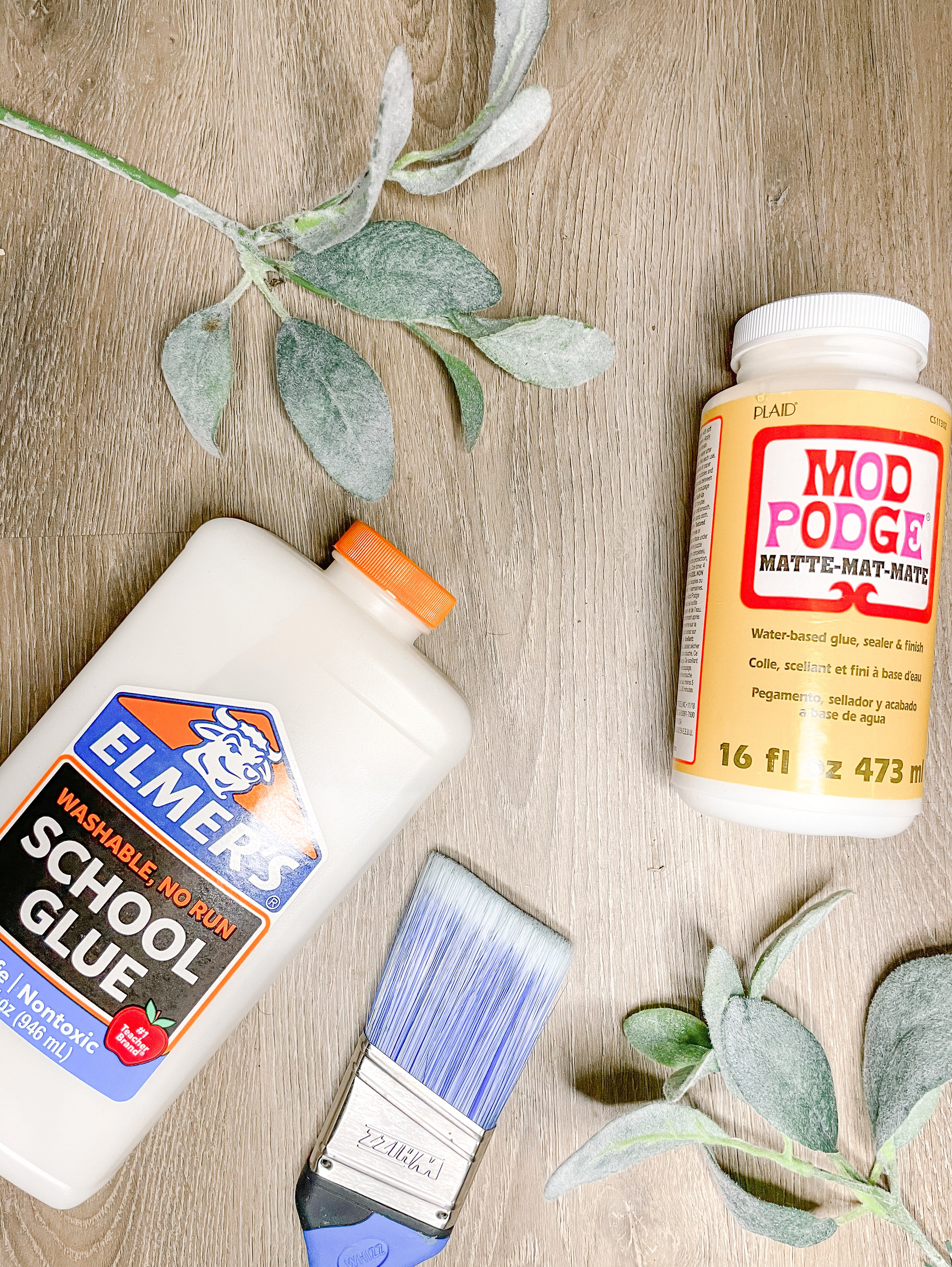
Mod Podge Vs. Elmer’s Glue

Mod Podge can be directly applied to paper with or without dilution via water, and is the more popular choice for decoupaging. The ingredients of Mod Podge are made up mainly of water and polyvinyl acetate, a common ingredient in most white glues. The main difference between this and other crafting glues is that Mod Podge goes an extra step beyone other glues and adds ingredients make this glue superior for glueing, sealing, and finishing—regular craft glues typically are only typically good for gluing.

But Modge Podge can get expensive, especailly when applying to a large surface area, so when I heard about the cheaper hack that uses a watered down Elmer’s Glue I knew I needed to try it.

According to a basic google search, the ratio to create “home made modge podge” from Elmer’s glue is 1/3 cup water for every 2/3 cups of Elmer’s glue. So I mixed some up and got to work to put it to the test

My Project

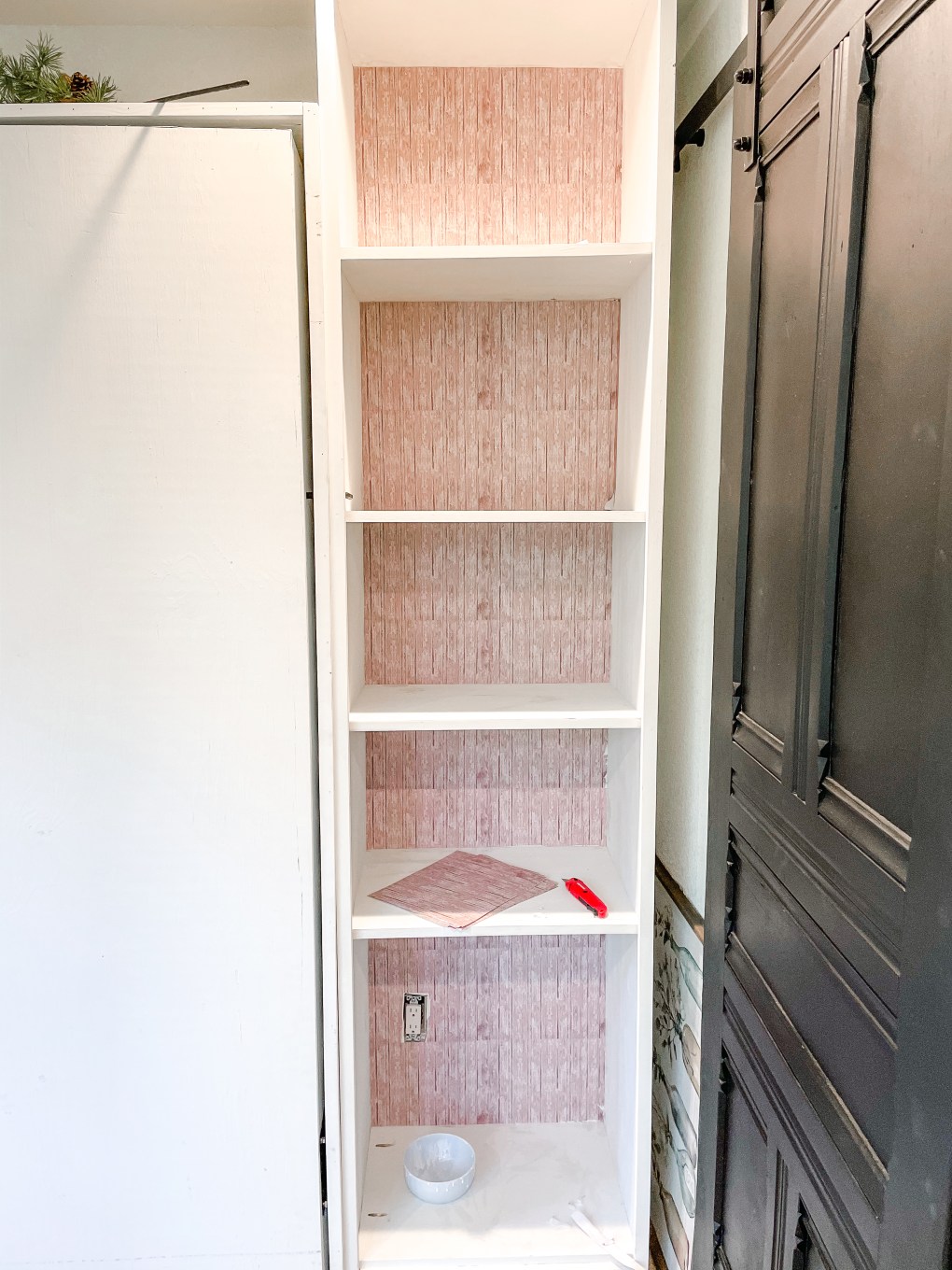
I decided to add paper to the back of my Murphy Bed shelves to give a fun contrast. (This was before I decided to paint them, but I love how the paper looks against my color choice). I used 12×12 sheets of scrapbooking paper, purchased from Hobby Lobby. I originally chose the more pink paper to the left, but after applying it I switched it out for the right. Not really relevant to this experiment, but notable nontheless.

Because I have two sets of shelving, Mod Podge was applied to the left, and the Elmer’s mixture was used to apply the right. I used the same technique as described above. After allowing both sides to fully dry, I was able to cut the excess paper with a box cuter knife to give relatively clean edges.

My Conclusion

I found the Elmers mixture a little frustrating to work with. It did not seem to stick as well, and left significantly more air bubbles between the surface of the shelf wall and my paper. Because this won’t get too much contact and wear, I think it will hold up alright, but definetly would have used the Mod Podge on both sides.

I think the Elmer’s mixture may work better with a less dilute ratio, and for me it did technically work, it just isn’t my favorite. The end result is still beautiful, and I love how easily this technique can transform a piece, but I guess I’ll be sticking with the real deal for now!

Talk soon,

xx, Lanna


Easiest DIY Bathroom Shelf Transformation

Okay y’all, this may be the simplest yet most satisfying project I have done yet! We have given this little house so many additions to make our space functional, yet visually appealing and I have been dying to put these shelves up in our bathroom. This house definetly has challeneged us to simplify and cut back on unneccecary items, yet condensing our bathroom was continually a struggle. We needed something that was pretty, and functional to hide all of our toiletries, hair products, medicines, towels, etc… all in a 2.5X 5 ft space above the toilet. What we had previously definitely was not working in our favor.

Cue our bathroom shelves. I say these were one of the easiest projects to date, mainly because the hardest part was waiting for the stain on our wood to dry so I could put it all together! It’s very rare that I finish a project in one day but these I finished in about 2 hours not including stain dry time-and I only bought the brackets for the assembly of this project, everything else I used I had on hand! WINS all over the place!

I first started off with these L brackets from Hobby Lobby, which at the time were 50% off. I ordered 2 for each shelf, a total of 8. Hanging these guys was super simple-I measured the center of the space above the toilet, then measured 6 inches out to find the where each bracket would sit. Next, I placed my right bracket up against my edge reference point and used a pencil to mark where the screwholes were. Taking a drill bit, I then made a pilot hole for my drywall screws since these would not be in studs. After inserting the anchor, I replaced the bracket and secured it using screws. I used a level to find the placement for the left bracket, and repeated the steps used for the right. I measured 16 inches down for the next shelves and repeated until all 8 brackets were securely in place.

Once the shelving brackets were in place, it was time for the stain. I reused some wood we had laying around in the barn, which measured approx. 1/2 thick and 11 1/2 wide. This would leave a slight gap in the back of the shelves but since this saved me from having to go buy more wood I wasn’t converned-and in the end it doesn’t even show. Retrospectively I would have stained the wood first to save on drying time, but se la vie.

After cutting my wood piece down to 18 inches long, I sanded with 220 grit to give a smooth, refreshed surface for my stain to adhere to. Next, I applied Minwax Pre-Stain (think of this as conditioner for your hair, this step preps the hair and gives a smooth surface for the next product to adhere to evenly). Minwax Early American as my stain color of choice, and since I used scrap wood this was a gamble if it would match the other wood accents in my bathroom. Because stain looks different on every single different type of wood, I typically would test my stain colors but I didn’t have any spare pieces to test. Thankfully this ended up matching close enough for me.

After the stain dried, it was time to assemble and decorate the shelves! I attached the wood to the L brackets with what I calle “baby screws” or #8 wood screws, and there yout have it! Easy, beautiful, functional storage that transformed our bathroom! Do you love them as much as I do? Because after I finished decorating these I could not stop staring! I will link all the bathroom decor on my shop page here!

Talk soon,

xx Lanna